by Omar Martinez
I recently finished my fourth year of teaching at a school site that was also my alma mater. I graduated in 2010 and had the pleasure not only of seeing the school as a student but also of returning to see the campus as a teacher. Although I was fortunate to be given this opportunity, things did not turn out as I had imagined they would in the teaching credential program. I quickly found out that new teachers have many more problems to deal with that a teaching credential program could never fully prepare you for. Needless to say, it led to anxiety, car breakdowns, and regret, and it heightened my imposter syndrome (more on that later), which I still have to this day.
BUT! Things are not always doom and gloom. Over 300 teachers and I were let go from one of the largest districts in southern California, which has made me reflect on my time at my school site and the past four years of my professional and personal life. I left not on my own will, but I am now prepared with information that, looking back, I desperately needed to hear in my first or even second year of teaching (I almost quit teaching twice in these two years). So, as a relatively new teacher, and I hold that title with honor, here are the five lessons that I wish someone would have told me before I embarked on my teaching journey:
1. “Veteran” Doesn’t Always Mean “Available” – And That’s Okay
Your mileage and experiences with this tip may vary from person to person and school to school, but hear me out. Every school has those veteran teachers who are role models; they are respected, seasoned, and loved by all. These veterans naturally translate to them also being teachers who have near-infinite resources at their disposal, will hear out all of your problems, and guide you on the ever-demanding journey that is teaching, right? Well, think about it: no matter how many years of experience they have, they are also dealing with issues and loads of work that they also have to deal with. Not to mention, what they recommend or have used in the past might not be suitable for you or your students, so take what they say with a grain of salt.
For example, I remember walking into school on the very first day and meeting all the teachers, being introduced to the school, and participating in those icebreakers that the admin makes everyone do, which everyone hates, but I mean loves. Best of all, I got my new classroom. Then the realization hit, “What am I going to do next week when school starts?” I sat in my classroom and ran through several ideas of what I could do, but I decided to gain some insight from other teachers, especially since many of the English teachers were my teachers when I was in school.
What I got was honestly nothing—well, nothing of use. The department chair, who was my AP Lit and Lang Teacher, pointed me towards the district-recommended curriculum and gave me a roadmap and tips, but even said, “Your experience might be limited as many teachers do not like that curriculum, so use what works for you.” It was not the best news to hear, but it was better than nothing. I then went to four other teachers who were teaching the same grade level as me and was told, “Eh, you can do whatever you want, honestly, but don’t use the district curriculum; it does not work for our students as it is too complicated.” I received conflicting viewpoints and found myself back where I started.
From this, you can see that my experiences with veteran teachers were limited, particularly in terms of curriculum. This trend also continued when it came to recommendations for teaching strategies, pedagogy, classroom management, and so on; it was not helpful to me. I am not saying to be a shut-in and not talk to anyone, especially veteran teachers. I suggest going out and meeting your colleagues, getting to know them a little, and who knows, you might receive some valuable advice that you wouldn’t have gotten otherwise. Don’t expect them to hand you the golden fruit that will solve all your problems. Which leads me to…
2. Find Your Fellow First-Years—You’ll Grow Together
One of the best things to do is to find fellow first-year teachers or new teachers and build a working relationship with them. No one understands each other more than new teachers. They will be there whenever you need resources, someone to vent to about any issues you’re having, or to celebrate anything worth celebrating with you. New teachers will be there for you if you ever need anything, and they are the primary resources that will not only help you survive as a teacher but thrive as a teacher.
Going back to my first year of teaching and the lack of advice from veteran teachers, my biggest form of support came from another first-year teacher across the hall from me, whom we will call Mrs. V. We were partially introduced on the first day of training. Both realized we were in the same situation, unsure of what to teach or even how to prepare it. We then decided to plan together and coordinate all our classes, which was easy since we both taught the same grade levels. Had it not been for this working relationship with Mrs. V, I would not have been as good of a teacher as I thought, and it made the work days so much easier. Collaboration with Mrs. V continued for the first and second years of my teaching, as Mrs. V was let go at the end of her second year.
In my third year of teaching, I was left without a working partner, as there were new teachers. However, we were teaching different classes, and I did not have the pleasure of getting to know them since our classes were on opposite ends of the campus. The only thing that helped me was that Mrs. V was still willing to work with me and help me, even though she no longer worked at my school and had moved to a different district. In the fourth year, however, I decided to work with the same newer teachers, Ms. D and Ms. S, as we were in neighboring buildings. Again, it felt amazing to have teachers I could work with and depend on when needed.
My forms of collaboration included casual discussions during passing periods, sitting together for lunches, meetings, and even after-school get-togethers and dinners. The partnership doesn’t have to be overly formal, where you set aside time to work on resources or anything special. It can be as simple as casual conversations, grabbing food or coffee, or even just sharing ideas and memes in group chats. Setting up a group chat, gathering everyone’s email addresses, and hosting a shared Google Drive that serves as a resource accessible to all. It helped me feel more supported and prepared in my teaching, and I was able to focus on in-person classroom situations rather than staying late to work on lesson plans. Lesson plans were also collaborative and shared among us. I strongly recommend collaborating with newer teachers.
3. Protect Your Peace: Set a Time to Leave Campus
Life as a teacher can be very tedious and time-consuming. Yes, you are required to teach classes for most of your day, but no one emphasizes the preparation needed for day-to-day instruction or even when planning for a week or so. There is always something to do, such as grading, planning, organizing, answering emails, and much more. The most significant thing I learned early on is to establish boundaries. If you do not set clear boundaries that you will follow, the job will consume your entire life, and you will work more than 10 hours a day.
In my first year, especially when I was figuring things out and planning for the first time, I stayed on campus way too late. I remember some days when I would stay so late that I had to call the janitor or DSO to open the parking lot gate, as they thought everyone had already left. All because I tried to plan over and prepare everything for every possible situation. Yeah, it seems bright to be ready, but there is such a thing as being overprepared. That first year, it was common to end the school day around 3:00 PM, yet I would stay late on campus until 6:30-7:00 PM. All because I wanted to catch up on planning for the next day, grading, emails, etc., but I was also navigating the challenges of teaching for the very first time.
My recommendation is to set an alarm to remind you to leave campus by a specific time. It may seem childish, but if you stick to it, your work and personal life balance will be better. I remember staying so late on campus that I would often miss birthdays, dinners, or social gatherings because I would get home so tired from planning that I would sleep the second I arrived, only to wake up and get ready for work again like a machine. It was not pleasant. If possible, have someone you live with call you if you are not home at a particular time and remind you to go home.

You can see my teaching alarms, and what I would do is set a new punishment that I would have to complete if I did not leave by a specific time. It changed weekly or monthly, depending on whether there was an event or something I was looking forward to. However, if that alarm went off, I would have to hold myself accountable and do the punishment. It takes willpower, but trust me, you don’t want to be the teacher who stays until the custodians start cleaning. Teaching is about you and the balance between the classroom and the students. Not planning or staying late to show that you are a hard worker. Save time for yourself.
4. Build Real Relationships—Teaching Starts with Trust
Your mileage may vary depending on several personal factors that are out of your control, but it’s okay either way. The thing you need to understand first and foremost is that teachers do not have to be “perfect” for students. Instead, focus on being an actual presence for them both physically in the classroom and digitally when using an LMS like Google Classroom or Canvas. Learn their names as soon as possible; I aim to do this by the end of the first or second week; the faster, the better. They are kids (teenagers, depending on their grades), and they want to learn as much about you as you wish to know about them, I assure you. If time allows and you don’t have prior commitments, attend their games, concerts, recitals, shows, or any other event, and show that you are a presence in their lives. Teaching is significantly easier when there is a strong teacher-student relationship. The instruction will come naturally.
During my first year, and even throughout my student teaching, I was THAT teacher. The one that would show up in a button-up shirt, dress pants, nice shoes, a tie, and looking like a professional in my area. Now, if this is you naturally, by all means, be yourself. The problem I encountered while teaching in the inner city was that students saw a person who did not relate to them and instead seemed to be there to think highly of themselves compared to the students. Their words, not mine. I recall that towards the end of the first semester of my first year, students asked me why I was dressing so “nerdily” according to them. They told me that it didn’t seem like it was me and that I was trying to be something I wasn’t. It’s a lesson that was thrown back at me when I told them always to be themselves a week earlier. They told me that it was okay to town it down a little, that the students would just as easily learn from me no matter what I wore. The following semester, I showed up for the first time in less formal clothing (a polo, nice black jeans, and a pair of Jordans 1s), and students immediately noticed and began talking. “Damn teacher, nice fit. Now you don’t look like a nerd anymore,” was the comment I heard the most. Surprisingly, students were more engaged in the teaching immediately on the first day. Over time, my style at work was just a reflection of my style outside of school, and I would show up in t-shirts, jeans, and sneakers every day. Just cause I did not dress professionally did not mean I was not on task. I always put my students first and their education; I just preferred to dress for comfort over professionalism. Sometimes, something as minuscule as the way you dress can mean a lot to students. You don’t have to act professionally or dress a particular part; just be authentic, and your professionalism will shine through in your craft, which is your teaching.
Another thing I strongly recommend is getting to know your students. To get to know them. Below, you will see a screenshot of my Canvas, which shows what my students would do every day when they walk into my class.
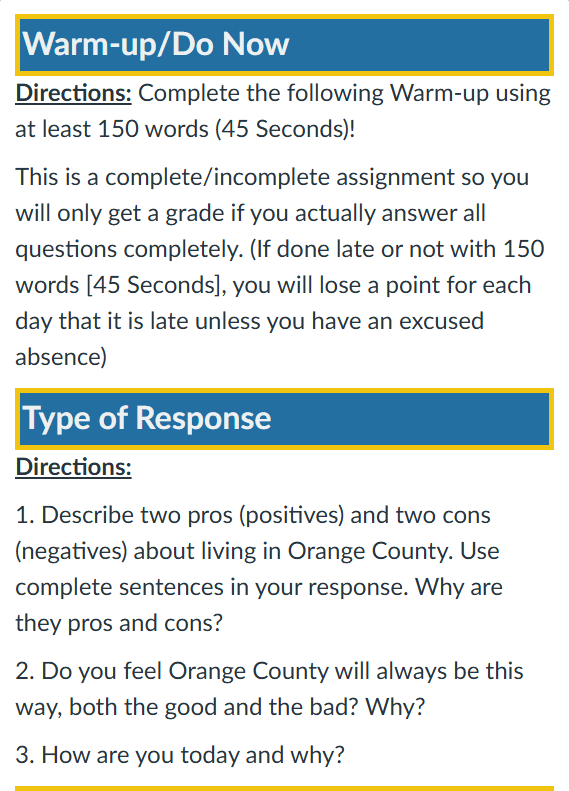
The first two questions connect to the lesson of the day or week, serve as a quick refresher, or even include fun community-building questions. The one thing they would answer every day is the third question: ‘How are you today?’ and ‘Why?’ This question goes a long way, but only if you make it meaningful. Many students want to talk to their teachers but feel that their teachers do not care for them. You need to set the standard that you will uphold and be an active presence in their lives. I would make it a goal of mine to read every student’s response when grading and always ensure that I follow up on responses the following day or by responding to them using the comment tab on Canvas. I learned about student interests, likes, dislikes, hobbies, and anything else you can think of.
The best part of this question is you can see how prepared or willing students are to engage in the class that day. If it’s a bad day for them, you can check in with them and make sure they’re okay, or you can use positive days to motivate them to keep that energy going throughout the day. Just from this warm-up alone, I was able to build connections with all my students, including a non-verbal student who loved responding to questions online but would not speak. Being nonverbal did not affect their performance in the class, but I always made sure they knew I would be present both physically and digitally. Being present also led to students opening up and sharing personal issues that were affecting them in class, such as things they needed help with and much more.
The best part is that many students would share their responses with the class. There would be no judgment, criticism, or anything; it would be students hearing each other out, and it would create an amazing collaborative environment. Sharing responses built connections and friendships and reduced any classroom issues among students, as everything was welcome for discussion. It was great. It taught me that connections build community and that community can dictate the personality and presence of the classroom.
5. Be Willing to Learn—You Don’t Have to Be the Expert Yet
The final tip may sound contrary to what it means to a teacher, but you must know it is okay to make mistakes. You don’t need to figure everything out, and honestly, no one will or does. Teaching is messy and very unplanned. A lesson that you spent meticulous hours working on could fall apart in seconds, and that is okay. You need to be willing to reflect on what you have done, revise things, and grow to become a strong and resilient teacher. Being able to do these things, take advice and criticism, and be open to change is what separates a weak teacher from a strong one.
In my experience, on the first day, I had to conduct an observation as part of my teaching contract. I meticulously planned a lesson that would be the perfect showcase of my teaching skills and organization. The lesson plan included timeframes, expectations, and areas for more in-depth learning, and everything taught in the teaching credential program aligns with what principals look for. Then came the day of the observation, and I was ready. The lesson was the next step in learning for the unit, but it depended on students understanding what they had learned over the past couple of days. As soon as I started the warm-up question to gauge students’ understanding of the prior lessons, everyone remained silent, as they were not prepared to move on to the following lessons. My meticulously planned lesson plan went out the window immediately while my principal was in the corner taking notes on a failed lesson that could decide my future as a teacher.
Instead of freezing on the spot, I pivoted. I immediately went to my computer and updated the prepared slides to cover the material from the previous days. The lesson changed from the next lesson to a review because students were unprepared. But the lesson went well. Students re-engaged with the prior day’s assignment because I could not simply move on. Students were more prepared and cooperated as usual. I even had students model their thinking and understanding on the whiteboard this time, something they had not done the previous day. This lesson became one of my favorites and showed me that you don’t have to plan everything; it’s okay to change things on the fly. If I had not done that, my students would have been unprepared, the lesson would have been a failure, and my observation would have been unfavorable (my principal later praised me for pivoting lessons so quickly and conducting a much-needed review). My students understood the lesson and were better prepared the next day.
Teaching is messy. It’s okay to prepare, but you don’t have to overprepare. This experience taught me that, yes, lesson plans are an essential skill to have in teaching, but they are changing. You can make changes and modifications in real-time; the key is to do what is best for your students. Always remember to stay open to new ideas, ask questions, make mistakes, reflect, and learn from them. Ultimately, this is what will determine whether you are an excellent teacher for your students, as you consider their interests first.
Final Thoughts!
If there’s one thing I’ve learned in these four whirlwind years, it’s that no one has it all figured out—and that’s okay. I’ve stumbled through underprepared lessons, stayed way too late trying to “do it right,” questioned my place in the classroom, and even considered walking away altogether. But through all of it, I’ve also discovered what truly matters: community, balance, presence, and the willingness to grow.
I still feel like a new teacher, and maybe I always will. But instead of seeing that as a weakness, I now wear it as a strength—proof that I’m still curious, still evolving, and still willing to adapt for the sake of my students and myself.
If you’re a new teacher reading this, or even a veteran who remembers what it felt like to be overwhelmed and unseen, I hope these reflections help you breathe a little easier. You’re not alone. Your work matters. And even when the lessons fall apart, the relationships and the learning still hold.
Let’s keep building something real—one honest conversation at a time.
5 Things I Wish I Knew as a New Teacher (From a Teacher Who’s Still Learning) © 2025 by Omar Martinez is licensed under CC BY-NC-SA 4.0


 Mr. M's New World Classroom